
Commercial pilot training that takes you all the way
An EASA-approved full-time education lasting 22-24 months. You start with no experience and finish as a commercial pilot with a frozen ATPL and 205 flight hours.
What you achieve with your pilot training
You finish with a frozen ATPL, the theoretical foundation that in time qualifies you to become a captain. In your logbook, you have 205 flight hours, 62 of them on twin-engine aircraft. On top of that, you get 40 hours of training in an Airbus 320 simulator. Together with your commercial pilot licence, your instrument rating, and an APS MCC course, you are ready to start as a first officer at an airline.
But certificates and hours are only half the story. When airlines hire, they value attitude over skills and knowledge combined. You graduate with the right attitude, because we train it systematically from day one.
%20(1).webp)
What does the pilot training require of you before you can start?
You need neither flying experience nor a high school diploma to start. The pilot training requires commitment, discipline, and the will to learn. Beyond that, there are a few formal requirements you need in place before you begin.

A programme that takes you from theory to commercial pilot
The training is structured in four modules. Each module focuses on exactly what you need at that point, and everything builds on what came before.
Theory
Here you lay the professional foundation for the rest of the training. You study 13 subjects that together give you the knowledge you need as a commercial pilot. Everything is based on aircraft like the Boeing 737 and Airbus A320.
The 13 subjects are:
- Air law
- Principles of flight
- Human performance and limitations
- Meteorology
- Flight planning and monitoring
- Operational procedures
- Aircraft general knowledge
- Navigation
- Mass and balance
- Instrumentation
- Radio navigation
- Performance
- Communication
The module is divided into three blocks of three months each, and after each block you must pass the corresponding exams. Once you have passed all 13, you have a frozen ATPL, the theoretical foundation that in time qualifies you to become a captain.
You also acquire two radio certificates in this module:
- BEG certificate for radio communication during visual flight
- GEN certificate for radio communication during instrument flight
Duration: approx. 9 months
Basic flying
With the theory in place, it is time to fly. You fly 75 hours in our Tecnam P2002JF under visual conditions, that is, in clear weather with the ground in sight. You learn the basic manoeuvres, navigation, and independent decision-making. Some of the training takes place from your home base, and some takes place in Spain.
In this module you fly your very first solo.
Duration: approx. 6 months
Advanced flying
This module consists of three parts: IFR, CPL, and UPRT.
In the IFR training, you learn to fly on instruments, that is, without visual reference to the ground. You fly in rain, fog, and above clouds in our twin-engine Tecnam P2006T and in the matching simulator. You finish with a skill test that gives you the right to fly multi-engine aircraft under instrument conditions.
In the CPL training, you focus on becoming a commercial pilot. Among other things, you train to handle passengers and emergencies, and you finish with a skill test that earns you your commercial pilot licence.
The final part is UPRT, which is training in unusual flight attitudes. You fly a Bellanca Decathlon with an aerobatics instructor and learn to recognise and handle situations that demand a fast and precise response.
Duration: approx. 7 months
APS MCC
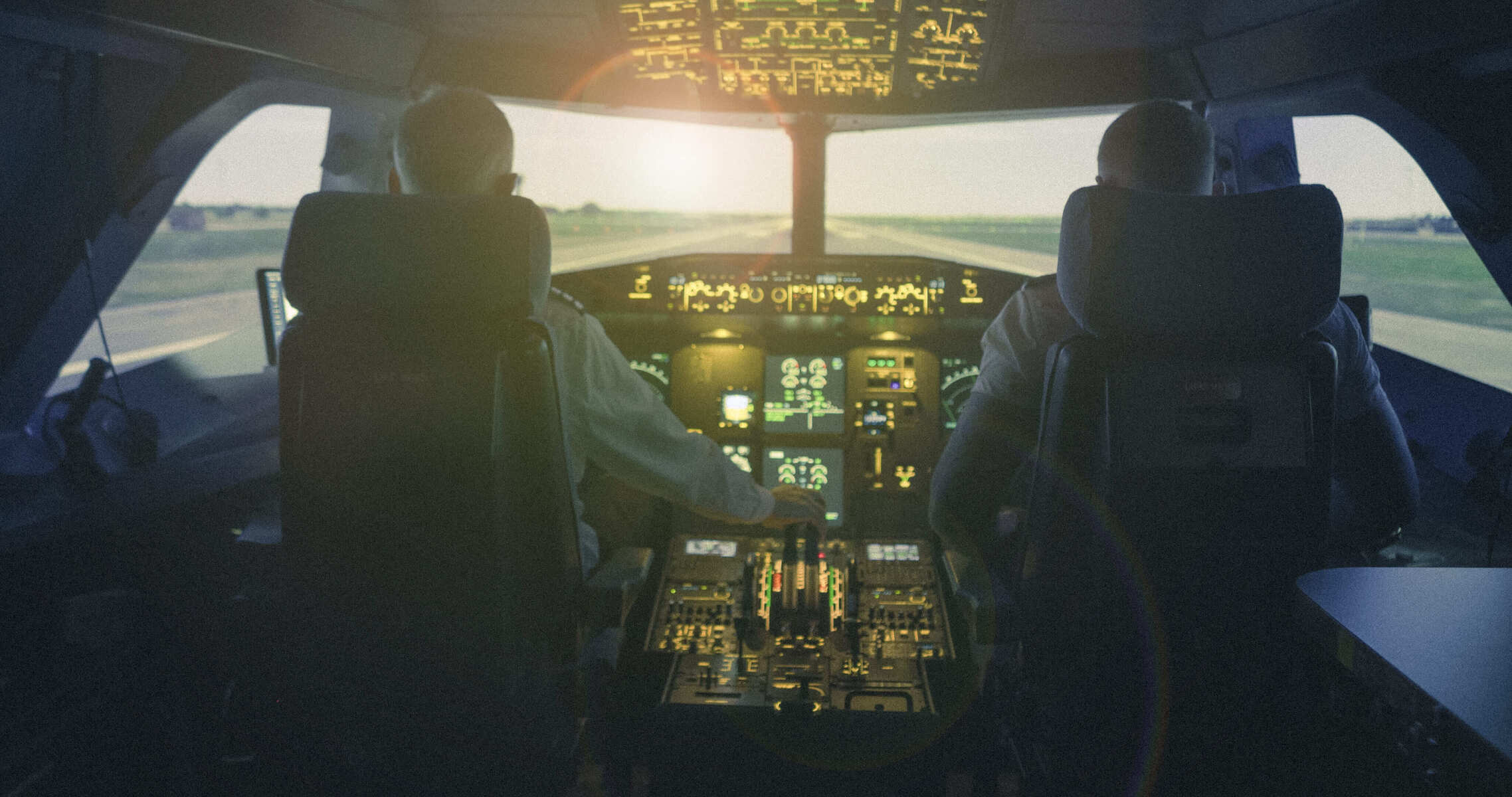
Now you move from small aircraft to large jets. APS MCC stands for Airline Pilot Standard Multi-Crew Cooperation, and the purpose is to prepare you to work as a first officer at an airline. All training takes place in our Airbus 320 simulator, a replica of a real Airbus cockpit with original components.
You practice cockpit cooperation, focusing on communication, division of responsibility, and decision-making as a team. 40 hours of training spread over 10 sessions, with thorough briefings before and after. Everything you have learned throughout the training now comes into play.
The course ends with an exam. After that you are ready to move on to a type rating, the final certification on the aircraft type you will fly at your future airline.
Duration: approx. 3 months
.jpeg)
.jpeg)
%2520(1).jpeg)
The career path as a commercial pilot
%2520(1).jpeg)
%2520(1).jpeg)
.jpeg)
Get answers to the essentials before you decide
Choosing a pilot training programme is a big decision, and it is only natural to want the basics in place first. Here are the answers to the questions we hear most often from future pilots.
What is the pilot training?
Pilot training in Denmark is a private, EASA-approved full-time education lasting two to three years. It typically costs EUR 94,000-107,000 and requires neither flying experience nor a high school diploma. You can also apply for the Danish Air Force's pilot training, which is free, but it does not grant civilian flight privileges.
Which jobs can I get as a pilot?
As a commercial pilot, you can fly commuter aircraft, medium-sized passenger aircraft, private jets, or work as a flight instructor. Most start as a first officer at an airline and build from there towards a captain's position. Your licence also qualifies you for cargo operations, long haul, corporate aviation and a career as a type rating instructor or examiner.
Can I have a part-time job on the side?
It is difficult. The pilot training is a full-time education that demands your full commitment, and your schedule can change at short notice. Most students choose to focus entirely on the training.
What if I fail an exam?
Then you try again. It costs a new exam fee, but so far no student has failed to complete the training because of failed exams.
Can I take the training part-time?
Yes. In addition to the integrated full-time education, we offer a modular education that can be tailored over 2 to 5 years. You get the same certificates and the same level of competence. Read more about the modular education here.
When can I start?
We admit students on an ongoing basis, and classes generally start in January and August. Your first step is to attend an info meeting and then pass an admission test. Find the next information meeting here.